
In an election at a special one-day meeting in Vienna, IAEA's 35-member board of governors appointed Pakistan Atomic Energy Commission's head, Ansar Parvez, as its chairman for the next one year. The Board is the most important policy-making body after the 151-nation general conference.
A crucial meeting of the board of governors of the International Atomic Energy Agency to build a consensus on India-specific safeguards accord essential to help implement Indo-US nuclear deal has been postponed from July 28 and is likely to be held on August 1, IAEA sources said.
Even before it faces the confidence vote in the Lok Sabha, the government will brief the International Atomic Energy Agency board of governors in Vienna on July 18 on the India-specific safeguards agreement, which the board is likely to discuss on August 1 to help the implementation of the Indo-US nuclear deal. India on Monday informed the 35 member-countries on the board of governors about the July 18 briefing, IAEA sources said.

Iran has put forward a comprehensive 10-point framework that it says forms the basis of a complete resolution.

By all available indications, the White House drafted a face-saving note and handed it, ready-made, to Islamabad. Pakistani Prime Minister Shehbaz Sharif was supposed to then post it in the guise of a plea urging Trump to extend the deadline by two weeks 'to allow diplomacy to run its course'. Trump would then graciously accept Pakistan's 'request' and declare a ceasefire. Sharif dutifully posted the message on X. Except that he, or whoever was handling the account, forgot to delete the tell-tale first line visible in the edit history: 'Draft - Pakistan's PM Message on X'. Prem Panicker's must read blog on the Iran War.
The safeguards pact, which is the next step in the operationalisation of the Indo-US civil nuclear deal, was sent to the 35-nation Board on a day when the Left parties formally withdrew support from the United Progressive Alliance government, following a bitter feud over the deal which has remained stalled for several months.
Lobbying for the Indo-US nuclear deal, India on Friday briefed the International Atomic Energy Agency Board of Governors and some Nuclear Suppliers Group countries on the safeguards agreement amid reports that there was no sign of opposition to the accord.
India has cancelled its briefing on the safeguards agreement for the members of the International Atomic Energy Agency, which was scheduled to be held in Vienna on July 18.The IAEA safeguards agreement is an essential step India has to take to integrate with international nuclear commerce before it secures a one-time waiver from the 45-nation Nuclear Suppliers Group.
India will brief the IAEA board of Governors on the safeguards agreement and other aspects of Indo-US nuclear deal tomorrow in Vienna ahead of the board's scheduled meeting on August one to reach a consensus on giving a waiver to India to do civilian nuclear trade.
The safeguards issue is unlikely to come up at Thursday's meeting of IAEA's Board of Governors and will come up for approval at a special Board meeting later. IAEA Director General Mohamed El-Baradei and Atomic Energy Commission chairman Anil Kakodkar initiated the talks.
Menon is expected to press India's case for allowing it to have civil nuclear cooperation with the international community. He is likely to cite India's impeccable track record on the non-proliferation front despite being a non-signatory to the NPT.
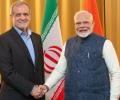
'Within minutes, my mobile began ringing. It was National Security Adviser Brajesh Mishra, asking why the Iranians were complaining.' 'I explained that we had only restated our position in the light of the conclusion reached by the IAEA, but will remain helpful to Iran to reach a consensus.' 'Then came a call from Foreign Secretary Kamal Sibal, repeating what Mishra said about the Iranian complaint.' 'I was very impressed that Iran was able to reach two top officials in India to intervene at short notice,' recalls Ambassador T P Sreenivasan.
India had gone along with the United States and European Union in voting against Iran at the last IAEA meeting in Vienna in September, triggering strong protests by United Progressive Alliance's left allies.

The Chernobyl nuclear power plant, which was taken over by Russian forces last month, has stopped transmitting data to the International Atomic Energy Agency (IAEA), the United Nations atomic watchdog has said, expressing deep concern for the staff working under Russian troops at the nuclear site in northern Ukraine.
Prime Minister Manmohan Singh will leave for Tokyo for the G8 Summit at 8 am on Monday. Dr Singh will met US President George Bush on July 9.

Earlier in the day, International Atomic Energy Agency chief Mohamed ElBaradei had endorsed the India-specific safeguards agreement, asserting that it conformed to "all legal requirements" of his agency and that talks had begun on a system of extended inspections.
He also complimented the United States for making it possible. The civil nuclear initiative was good for India and good for the world, he said in a statement.
The Congress on Thursday said it was wrong to interpret the request for convening the meeting of Board of Governors of IAEA as going to IAEA.
India on Friday joined the United States in voting against Iran in a resolution passed by United Nations atomic watchdog IAEA censuring the Islamic nation over its controversial nuclear programme and demanding that it stop uranium enrichment.
India on Friday said it could not ignore the conclusions of the International Atomic Energy watchdog IAEA on Iran's nuclear enrichment programme before deciding to vote against Tehran, but felt the door for dialogue with it should be open.
'The very fact that his autobiography is called India Rising is a correct example of his wish for India to be a developed country and do as best as possible by science reaching to the common people.'
The notification formalities were completed on Thursday night, a crucial step in paving way for the implementation of international civil nuclear cooperation, Department of Atomic Energy sources said.
The Left parties on Wednesday night said that the government's move to get the draft nuclear safeguards agreement circulated to the International Atomic Energy Agency's Board of Governors was 'expected', especially after Prime Minister Manmohan Singh's remarks that the nuclear watchdog will be approached very soon.The Bharatiya Janata Party expressed surprise about how the draft was circulated.
Following is the reaction of parties on the India-specific safeguards agreement being approved by the Board of Governors of the International Atomic Energy Agency.
IAEA puts off referring Iran to Security Council: Official
At a press briefing at Washington DC's National Press Club on the eve of the IAEA board of governors meeting, nonproliferation experts called on the NSG not to reach a consensus on the accord, since it was 'seriously flawed and would undermine the professed objectives of the NSG'

The reversal of Trump's policy with regard to Iran, like the withdrawal from the Paris Agreement, may not be a matter of just turning the clock back, but one of patient negotiations, with uncertain consequences in the post-COVID-19 world, observes Ambassador T P Sreenivasan.

The crises of the 21st century, 9/11, the economic meltdown, COVID-19, Russia-Iran war and the Hamas-Israel war seem to be never ending. In this situation, Iran might be contemplating a nuclear deterrent to defend itself, observes Ambassador T P Sreenivasan, the distinguished long-time Rediff contributor who turns 80 on June 17..
There is disappointment that such a high profile agency with great potential for peace and development has not attracted the enormous talent available wide world outside the Vienna International Centre, says T P Sreenivasan.
Not satisfied with the UPA's replies to their queries on the nuclear issue, the Left parties are likely to ask the government to finalise an India-specific safeguards agreement with International Atomic Energy Agency only after the 123 agreement with the US lapses.
The ominous explanations of some of the NSG countries in the Board should alert to the perils ahead.
A supporter of the N-deal gives a chilling insight into the deep conviction of the group of nuclear deal supporters in market economy and their unwavering faith in the inherent strengths of India.
Now that the United Progressive Alliance coalition has nine months in office, it must be transparent and accountable to those who pay and elect it to serve the people of India. A single mis-step on the 123 could irreparably damage rather than advance India's national interest
While accepting a proposal to get the uranium for its nuclear power programme enriched in Russia after some "fine tuning," Tehran threatened to launch industrial enrichment if the case was referred to the UN Security Council.

'I would urge my Indian friends to look at how significant the overall support was.'

The Nobel Prize for Malala may have caused deep divisions across the globe and disturbed the peace, while the award to OPCW, though not without critics, may have served the cause of peace by eliminating a weapon of mass destruction from the face of the earth, says Ambassador T P Sreenivasan.
 © 2026 Rediff.com - Advertise with us - Disclaimer - Privacy Policy - Sitemap - Feedback - About us - Terms of use - Grievances